
CJC-1295 and Ipamorelin are two of the most widely studied growth hormone secretagogues in compound research. When combined, they are investigated for their complementary mechanisms of action on the hypothalamic-pituitary axis. This guide covers what researchers need to know about both compounds, why they’re studied together, and how they’re supplied for laboratory use.
What Is CJC-1295?
CJC-1295 is a synthetic analogue of growth hormone-releasing hormone (GHRH), consisting of a modified 29-amino acid sequence. CJC-1295 exists in two forms studied in the literature: one with a Drug Affinity Complex (DAC) modification that extends half-life by binding to albumin in the bloodstream, and one without DAC, which behaves closer to native GHRH with a shorter duration of activity. The Certificate of Analysis for the batch Alpha Tides PNW currently supplies confirms the non-DAC form (see Product Specifications below). Research describing DAC-mediated half-life extension — including research on CJC-1295’s activation of the GH/IGF-1 axis — refers to the DAC form specifically, not necessarily the batch supplied here.
In research settings, CJC-1295 is studied for its ability to stimulate pulsatile growth hormone secretion from the anterior pituitary gland. Laboratory investigations have examined its effects on GH pulse amplitude, IGF-1 levels, and downstream signaling pathways.
What Is Ipamorelin?
Ipamorelin is a selective growth hormone secretagogue and ghrelin receptor agonist. It belongs to the growth hormone releasing peptide (GHRP) class of compounds and is noted in research for its high selectivity — it stimulates GH release without significantly elevating cortisol or prolactin levels, which distinguishes it from earlier GHRPs like GHRP-2 and GHRP-6. A broader review of growth hormone secretagogues and their receptor mechanisms covers this selectivity profile in more depth.
Ipamorelin acts on the ghrelin receptor (GHS-R1a) through a separate pathway from CJC-1295, making the two compounds a subject of interest for researchers studying synergistic GH secretagogue activity. Alpha Tides PNW does not currently supply Ipamorelin as a standalone vial — the CJC-1295 + Ipamorelin blend is the only way to access it in this catalog.
Why Are They Studied Together?
The CJC-1295 and Ipamorelin combination is frequently investigated in research because the two compounds act through distinct but complementary mechanisms. CJC-1295 stimulates GHRH receptors while Ipamorelin activates ghrelin receptors — together they are studied for producing a stronger and more sustained GH pulse than either compound alone.
Research into this combination has examined receptor binding kinetics, GH pulse frequency and amplitude, and interactions with the somatostatin feedback system. The timing difference between the two mechanisms is part of the interest: Ipamorelin’s ghrelin-receptor activity tends to act faster, while CJC-1295 sustains GHRH-receptor signaling over a comparatively longer window than native GHRH — together approximating a baseline-plus-pulsatile pattern rather than either single-mechanism profile alone. (As noted above, the degree of that extension depends on whether the CJC-1295 is the DAC or non-DAC form; the supplied batch is the non-DAC form.)
Reconstitution and Storage
Like other lyophilized research compounds, CJC-1295 + Ipamorelin is reconstituted with bacteriostatic water — see our step-by-step reconstitution guide for the general technique, or our peptide concentration calculator for the concentration and reconstitution measurements. Store the lyophilized vial at -20°C away from light and moisture; once reconstituted, refrigerate at 2–8°C and use within about 4–6 weeks, avoiding repeated freeze-thaw cycles. Full compound-by-compound storage notes are in our complete storage guide.
Product Specifications
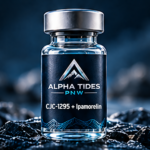
Alpha Tides PNW supplies CJC-1295 + Ipamorelin as a pre-blended lyophilized powder — 5mg of each compound (10mg combined weight) per vial, and the non-DAC form of CJC-1295, matching the product’s Certificate of Analysis. Each batch is independently tested by a third-party laboratory, with a Certificate of Analysis available in our COA library.
- Form: Lyophilized powder
- Dosage: 5mg CJC-1295 (non-DAC) + 5mg Ipamorelin per vial (10mg combined)
- Purity: 99%+ verified
- Storage: -20°C, away from light and moisture
Summary: Key Takeaways for Researchers
CJC-1295 and Ipamorelin are studied together because they act on separate receptors within the growth-hormone axis. The essential points for study planning are:
- Different receptors: CJC-1295 acts on the GHRH receptor; Ipamorelin acts on the ghrelin receptor (GHS-R1a) — a dual-pathway mechanism, not redundant signaling.
- Complementary timing: Ipamorelin’s ghrelin-receptor activity tends to act faster, while CJC-1295 sustains GHRH-receptor signaling over a longer window than native GHRH (the supplied batch is the non-DAC form, per its Certificate of Analysis).
- Supply format: Alpha Tides PNW supplies the two only as a pre-blended vial — Ipamorelin is not currently sold as a standalone compound.
- Documentation: review the specific batch Certificate of Analysis for the vial in hand rather than assuming a fixed specification.
Related Research Guides
- How to Evaluate Third-Party Tested Research Materials — what a real Certificate of Analysis should show
- Tesamorelin vs CJC-1295: GHRH Comparison — how CJC-1295 compares to another GHRH-axis compound studied in metabolic and GH-secretagogue research
Continue exploring at the Alpha Tides Research Hub, or browse the full research compound shop. Questions about a specific batch or order can go through our contact page.
CJC-1295 + Ipamorelin supplied by Alpha Tides PNW is intended strictly for laboratory and in vitro research purposes. It is not for human or animal consumption and has not been evaluated or approved by the FDA.
The compound(s) discussed in this article are available with a Certificate of Analysis on the Alpha Tides shop.
Frequently Asked Questions
The two compounds act on different receptors — CJC-1295 on the GHRH receptor, Ipamorelin on the ghrelin receptor (GHS-R1a) — so combining them is studied as a way to engage both arms of GH pulse regulation rather than just one. This dual-pathway approach is the basis for most of the research interest in the combination.
Not currently from Alpha Tides PNW — it's supplied only as part of the pre-blended CJC-1295 + Ipamorelin vial, not as an individual product.
DAC (Drug Affinity Complex) is a chemical modification that binds CJC-1295 to albumin in the bloodstream, extending its half-life relative to unmodified GHRH — this is why the DAC form of CJC-1295 is studied for sustained rather than brief GH-axis activity. The batch Alpha Tides PNW currently supplies is the non-DAC form, confirmed by its Certificate of Analysis; researchers should account for the shorter expected duration of activity accordingly.
The same way as other lyophilized research compounds — bacteriostatic water, added gently to the side of the vial rather than directly onto the powder. See our reconstitution guide for the full step-by-step process and the peptide concentration calculator for concentration math.
Research Compounds
Research Use Only — Not for Human or Animal Consumption. Content is provided for informational and educational purposes and does not constitute medical advice.
Continue Your Research
Browse the full catalog of COA-verified research compounds.
Shop All Compounds →