

BPC-157 is among the most frequently referenced repair-pathway compounds in the preclinical research literature. This guide summarizes what BPC-157 is, how it is thought to act in the biological systems researchers study, and the practical laboratory considerations that shape reproducible experiments. It is written for qualified researchers evaluating the compound for in vitro and preclinical work, and it makes no human-use, therapeutic, or dosing claims.
Understanding a compound before designing a study reduces wasted material and ambiguous results. The sections below cover BPC-157’s structure and origin, the signaling pathways most often examined, common study categories, handling requirements, and the documentation that keeps experimental variables under control.
What Is BPC-157?
BPC-157 (Body Protection Compound-157) is a synthetic pentadecapeptide — a chain of 15 amino acids — derived from a protective protein sequence identified in human gastric juice. Its amino-acid sequence is Gly-Glu-Pro-Pro-Pro-Gly-Lys-Pro-Ala-Asp-Asp-Ala-Gly-Leu-Val, with a molecular weight of approximately 1419.5 Da. Because it is a partial sequence rather than a complete native protein, it is manufactured synthetically for research use and supplied as a lyophilized (freeze-dried) powder that is reconstituted before laboratory application.
The “157” designation refers to its identification within a larger gastric protein studied for cytoprotective properties. In research contexts, BPC-157 is valued partly for its stability: unlike many peptides that degrade rapidly in acidic environments, it has demonstrated resistance to degradation under gastric-acid conditions in preclinical studies. This characteristic is one reason it became a common tool in gastrointestinal research models, where compound survival in a low-pH environment is otherwise a limiting factor.
Discovery and Research Background
BPC-157 emerged from investigations into the cytoprotective components of gastric juice, a line of research exploring why the stomach lining tolerates a highly acidic environment. From that work, the 15-amino-acid fragment was isolated and synthesized for controlled study. Over the following decades, it accumulated a substantial preclinical literature, most of it centered on rodent models, spanning gastrointestinal integrity, connective-tissue repair, and vascular signaling.
Because the great majority of BPC-157 findings come from animal and cell-based systems, results are interpreted strictly within a preclinical framework. Researchers treat the compound as an experimental tool for probing repair-related pathways rather than as an established intervention, and study designs are built around that framing.
Studied Mechanisms and Pathways
Across published preclinical work, BPC-157 has been examined in several overlapping signaling contexts. Investigators generally frame these in terms of tissue-repair and vascular pathways rather than a single defined mechanism.
Angiogenesis and VEGFR2 Signaling
One of the most studied properties of BPC-157 is its apparent influence on new blood-vessel formation. Preclinical studies have reported upregulation of VEGFR2 (vascular endothelial growth factor receptor 2) expression in response to the compound, suggesting a role in vascular growth signaling that is frequently investigated in wound-repair and ischemia models — summarized in a literature and patent review of BPC-157’s proposed mechanisms and applications. Because angiogenesis underlies many tissue-repair processes, this pathway is central to how researchers interpret the compound’s broader activity.
Growth-Factor and Cytokine Modulation
Research has also examined how BPC-157 interacts with growth-hormone receptor expression and with pro-inflammatory cytokine cascades. In several models the compound is associated with reduced inflammatory signaling alongside enhanced repair-pathway activity, which is why it appears in both gastrointestinal and musculoskeletal research designs where inflammation and repair are studied together.
Nitric-Oxide Pathway Interaction
A recurring theme in the literature is BPC-157’s interaction with the nitric-oxide (NO) system, which governs vascular tone and endothelial function. This has made it a subject of interest in studies exploring vascular and cytoprotective signaling, and it connects the compound’s angiogenic and anti-inflammatory associations under a shared vascular-biology umbrella.
Common Research Applications
Investigators typically position BPC-157 in one of several study categories:
- Gastrointestinal models: mucosal integrity, ulcer models, and NSAID-induced injury studies.
- Musculoskeletal tissue models: tendon, ligament, and muscle repair research under normal and compromised conditions.
- Angiogenesis research: vascular growth signaling and endothelial studies.
- Inflammatory signaling: cytokine cascade modulation in inflammation models.
- Comparative repair studies: side-by-side designs with related compounds such as TB-500.
BPC-157 is often studied alongside TB-500 (a Thymosin Beta-4 fragment) in comparative repair research; for a side-by-side look at how the two differ mechanistically, see the comparison guide linked below.
Research Considerations and Study Design
Reproducible BPC-157 work depends on controlling a handful of variables that are easy to overlook. Compound identity and purity are foundational: two vials with different purity profiles can produce divergent results even under identical protocols, so purity should be treated as a documented experimental parameter rather than an assumption. Reconstitution practice matters as well — solvent choice, mixing technique, and the age of the reconstituted solution all influence peptide integrity.
Because BPC-157 is studied across several tissue systems, appropriate controls and model selection are essential. A gastrointestinal-model design and a tendon-repair design place very different demands on the compound and the readouts, and results from one context should not be generalized to another without supporting data. Planning storage and reconstitution logistics in advance helps ensure that material remains within its stable window across the full duration of a study.
Quality and Documentation
For any repair-pathway study, compound identity and purity are the foundation of interpretable data. Research-grade BPC-157 should be accompanied by a Certificate of Analysis (COA) that documents purity — typically by HPLC — and confirms identity, often supported by mass-spectrometry data. Verifying this documentation before a study begins removes a major and otherwise invisible source of experimental variability.
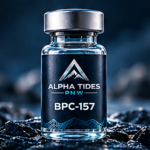
Alpha Tides PNW supplies BPC-157 as a 10mg lyophilized powder at ≥99% purity, with third-party COA documentation available directly on the product page. Reviewing the batch-specific COA and recording its identifiers alongside experimental notes creates a traceable link between results and the exact material used.
Summary: Key Takeaways for Researchers
BPC-157 is one of the most cited repair-pathway compounds in preclinical literature. The essential points for study planning are:
- Preclinical evidence base: the great majority of findings come from animal and cell-based models — results should be interpreted within that frame, not extrapolated to human outcomes.
- Multiple overlapping pathways: angiogenesis/VEGFR2 signaling, growth-factor and cytokine modulation, and nitric-oxide pathway interaction are the most studied mechanisms, generally treated as a connected profile rather than one defined mechanism.
- Stability is notable: BPC-157’s reported resistance to degradation in acidic, gastric-like conditions is part of why it appears so often in GI research models.
- Documentation matters: purity and identity should be treated as documented experimental parameters — review the batch-specific COA rather than assuming a figure.
Related Research Guides
- BPC-157 vs TB-500: A Researcher’s Comparison Guide
- BPC-157 10mg (research compound)
- Certificates of Analysis
Research Use Only. BPC-157 and all compounds referenced here are intended strictly for laboratory research by qualified professionals. They are not FDA approved and are not for human or animal use. Nothing in this article constitutes medical, therapeutic, or dosing guidance.
Storage & Handling
Proper handling preserves compound integrity and keeps research data reproducible.
- Before reconstitution: store lyophilized vials at −20°C, protected from light and moisture. Allow a vial to reach room temperature before opening to avoid condensation.
- After reconstitution: refrigerate at 2–8°C and use within roughly 28 days. Avoid repeated freeze-thaw cycles, which accelerate degradation.
- Recommended solvent: bacteriostatic water is the standard choice for multi-use reconstitution.
For full protocols, see the reconstitution and storage guides in the Related Research section.
The compound(s) discussed in this article are available with a Certificate of Analysis on the Alpha Tides shop.
Frequently Asked Questions
BPC-157 is studied primarily in tissue-repair models (gastrointestinal, musculoskeletal, and dermal), angiogenesis and VEGFR2 signaling, and inflammatory-cytokine research. It is one of the most cited repair compounds in preclinical literature.
BPC-157 is a 15-amino-acid compound derived from a gastric protein sequence with well-studied gastrointestinal and connective-tissue applications. TB-500 is a synthetic fragment of Thymosin Beta-4 focused on actin regulation and cell migration. Both are studied for tissue repair but through distinct mechanisms.
Preclinical studies report that BPC-157 resists degradation in acidic, gastric-like conditions, unlike many peptides. This stability profile is one reason it is frequently used in gastrointestinal research models.
Store lyophilized vials at −20°C away from light and moisture. After reconstitution with bacteriostatic water, refrigerate at 2–8°C and avoid freeze-thaw cycles.
Research-grade BPC-157 is typically ≥99% pure by HPLC, documented on a batch-specific Certificate of Analysis. Reviewing the COA before use helps ensure reproducible results.
Bacteriostatic water is the standard solvent for multi-use laboratory reconstitution because its preservative supports repeated sterile access over the working life of the vial.
Research Compounds
Research Use Only — Not for Human or Animal Consumption. Content is provided for informational and educational purposes and does not constitute medical advice.
Continue Your Research
Browse the full catalog of COA-verified research compounds.
Shop All Compounds →