

Tesamorelin and CJC-1295 are both growth hormone-releasing hormone (GHRH) analogs, which places them in the same mechanistic family within growth-hormone-axis research. Because they share a receptor target but differ in structural details and signaling profile, they are frequently compared. This guide examines how tesamorelin and CJC-1295 differ, and how researchers select between them for GH-axis studies. It is written for qualified researchers and makes no human-use, therapeutic, or dosing claims.
Both compounds act on the GHRH receptor rather than the ghrelin receptor, distinguishing them from secretagogues such as GHRP-2 and ipamorelin. The sections below cover the GHRH pathway, the structural and signaling differences between the two analogs, and study-design considerations.
The GHRH-Analog Class
GHRH analogs are synthetic compounds that mimic endogenous growth hormone-releasing hormone, stimulating the pituitary through the GHRH receptor to promote growth-hormone release. Because native GHRH is short-lived, analogs are engineered for greater stability and more sustained receptor engagement, making them practical experimental tools. Both tesamorelin and CJC-1295 fall into this class, and both are studied for how sustained GHRH-receptor stimulation influences the GH axis.
Tesamorelin: Structure and Research Profile
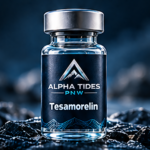
Tesamorelin is a stabilized GHRH analog based closely on the native GHRH sequence with a modification that improves its stability. In research contexts it is studied as a GHRH-receptor agonist for its effects on growth-hormone release and downstream IGF-1 signaling, and it has a well-characterized profile in metabolic-research models. Its close relationship to native GHRH makes it a useful reference GHRH analog.
CJC-1295: Structure and Research Profile
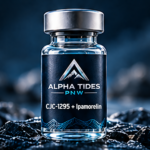
CJC-1295 is a GHRH analog studied in two forms — with a Drug Affinity Complex (DAC) modification for extended receptor engagement, and without DAC, closer to native GHRH in duration. Research interest in the DAC form centers on sustained stimulation of the GHRH pathway and prolonged GH and IGF-1 signaling in preclinical models. CJC-1295 is frequently studied in combination with ghrelin-receptor agonists such as ipamorelin, where the two mechanisms are examined together to model complementary GH release. (Alpha Tides PNW’s CJC-1295 + Ipamorelin blend supplies the non-DAC form — see the CJC-1295 + Ipamorelin guide for details.)
Key Differences for Study Design
| Feature | Tesamorelin | CJC-1295 |
|---|---|---|
| Structural basis | Stabilized analog closely resembling native GHRH | Modified GHRH analog; studied in DAC (extended) and non-DAC forms — Alpha Tides PNW supplies the non-DAC form |
| Signaling duration | Profile closely tracks native GHRH | DAC form: extended, sustained signaling. Non-DAC form: shorter, closer to native GHRH |
| Typical research role | Reference GHRH analog; well-characterized metabolic-research profile | Combination pharmacology, often paired with a ghrelin-receptor agonist |
| Common study design | Studied on its own as a GHRH-analog reference | Frequently studied alongside Ipamorelin or similar GHRPs |
Signaling Duration
The most discussed distinction is the duration of receptor engagement. CJC-1295 is generally studied for its prolonged signaling profile, whereas tesamorelin’s profile is often framed in relation to its close resemblance to native GHRH. Time-course design should reflect these differences.
Combination Research
CJC-1295 appears very frequently in combination-study designs alongside ipamorelin, making it a common choice when researchers want to model dual-pathway GH stimulation. Tesamorelin is more often studied on its own as a GHRH-analog reference.
Research Context
Tesamorelin has a well-established profile in metabolic research models, while CJC-1295 is often selected for GH-axis and combination pharmacology work. The intended research question usually drives the choice.
When Researchers Choose Each Compound
- Choose tesamorelin as a native-like GHRH-analog reference, particularly in metabolic-research contexts.
- Choose CJC-1295 for studies emphasizing prolonged GHRH-receptor engagement or combination designs with a ghrelin-receptor agonist.
- Compare both to examine how structural differences within the GHRH-analog class affect signaling duration and downstream IGF-1 response.
Research Considerations
Because both compounds act on the same receptor, isolating the effect of structural differences requires careful, parallel design under identical conditions. Time-course sampling is especially important given the emphasis on signaling duration; a single time point may not capture the distinctions between the two analogs. Including appropriate controls and, where relevant, a ghrelin-receptor agonist arm helps place the GHRH-analog results in context.
Purity and reconstitution discipline apply as with any lyophilized peptide. Documenting each compound’s batch Certificate of Analysis and keeping reconstituted material within its stable window ensures that observed differences reflect pharmacology rather than degradation.
Designing a Tesamorelin vs CJC-1295 Comparison
Because tesamorelin and CJC-1295 act on the same GHRH receptor, a comparison between them is fundamentally a study of how structural differences within one mechanistic class translate into different signaling behavior. The most informative designs run both compounds in parallel arms under identical reconstitution, concentration, and storage conditions, with a time-course sampling schedule dense enough to capture differences in the duration of the growth-hormone response. A single time point risks missing the very distinction — signaling duration — that most clearly separates the two analogs.
Researchers frequently extend such a comparison to include a ghrelin-receptor agonist arm, since GHRH analogs are often studied alongside compounds like GHRP-2 or ipamorelin. Adding that arm places the tesamorelin-versus-CJC-1295 contrast in the broader context of the two secretagogue families and clarifies how within-class differences compare to across-class differences. Throughout, appropriate vehicle controls and documented batch Certificates of Analysis keep the results attributable to pharmacology rather than to material variability, and recording COA identifiers alongside experimental notes preserves traceability across a multi-arm study.
Summary: Key Takeaways for Researchers
Tesamorelin and CJC-1295 are two GHRH analogs that share a receptor target but differ in structural detail and signaling behavior. The essential points for study planning are:
- Same class: both act on the GHRH receptor, distinct from ghrelin-receptor agonists such as GHRP-2 and ipamorelin.
- Profile difference: CJC-1295 is often studied for prolonged receptor engagement, while tesamorelin closely resembles native GHRH and has a well-characterized metabolic-research profile.
- Combination context: CJC-1295 appears frequently in combination designs with a ghrelin-receptor agonist; tesamorelin is more often studied on its own as a reference analog.
- Design discipline: use dense time-course sampling, matched conditions across arms, and documented Certificates of Analysis to keep results attributable to pharmacology.
Comparing these two analogs within a single, carefully matched design lets researchers isolate how structural differences within the GHRH-analog class translate into differences in signaling duration and downstream IGF-1 response.
Related Research Guides
- Tesamorelin Research Guide
- What Is CJC-1295 + Ipamorelin? A Researcher’s Guide
- GH Secretagogues: GHRH Analogs vs Ghrelin Agonists
- Tesamorelin (research compound)
- CJC-1295 + Ipamorelin (research blend)
- More Research Guides
Research Use Only. Tesamorelin, CJC-1295, and all compounds referenced here are intended strictly for laboratory research by qualified professionals. They are not FDA approved and are not for human or animal use. Nothing in this article constitutes medical, therapeutic, or dosing guidance.
Storage & Handling
- Before reconstitution: store lyophilized vials at −20°C, protected from light and moisture.
- After reconstitution: refrigerate at 2–8°C and use within roughly 14–28 days; avoid freeze-thaw cycles.
- Recommended solvent: bacteriostatic water, handled under sterile technique.
The compound(s) discussed in this article are available with a Certificate of Analysis on the Alpha Tides shop.
Frequently Asked Questions
Yes. Both are GHRH analogs that act on the GHRH receptor, distinct from ghrelin-receptor agonists such as GHRP-2 and ipamorelin.
They differ in structural details and signaling profile. CJC-1295 is often studied for prolonged receptor engagement, while tesamorelin closely resembles native GHRH and has a well-characterized metabolic-research profile.
CJC-1295 is frequently combined with ipamorelin to model dual-pathway GH stimulation. Tesamorelin is more often studied on its own as a GHRH-analog reference.
Both are lyophilized peptides best stored at −20°C before reconstitution and refrigerated at 2–8°C afterward, with freeze-thaw cycles avoided.
Because much of the distinction between them concerns signaling duration, sampling schedules must be designed to capture the time profile rather than a single arbitrary point.
Each should have a batch-specific Certificate of Analysis confirming HPLC purity and identity for reproducible comparison.
Yes. They are commonly run in parallel arms to compare signaling duration within the GHRH-analog class, sometimes with an added ghrelin-receptor agonist arm for broader context.
No. They share a receptor target but differ in structural detail and signaling profile, so researchers select based on the specific question being studied.
Research Compounds
Research Use Only — Not for Human or Animal Consumption. Content is provided for informational and educational purposes and does not constitute medical advice.
Continue Your Research
Browse the full catalog of COA-verified research compounds.
Shop All Compounds →