

DSIP (Delta Sleep-Inducing Peptide) is one of the more extensively documented neuropeptides in preclinical sleep research, yet it remains one of the least-covered compounds on this site relative to the depth of literature behind it. This guide summarizes what DSIP is, the pathways researchers study it through, and the laboratory handling considerations that keep results reproducible. It is written for qualified researchers evaluating the compound for in vitro and preclinical work, and it makes no human-use, therapeutic, or dosing claims.
The sections below cover DSIP’s discovery and structure, the six research areas it appears in most often, how it’s positioned relative to other compounds in recovery-and-recuperation research, handling requirements, and documentation.
What Is DSIP?
DSIP is a naturally occurring nonapeptide — a chain of nine amino acids (H-Trp-Ala-Gly-Gly-Asp-Ala-Ser-Gly-Glu-OH) — first isolated in 1977 by Swiss researchers from the cerebral venous blood of rabbits. Its molecular formula is C35H48N10O15, and it carries CAS number 62568-57-4. DSIP is endogenously present in the hypothalamus, limbic system, pituitary gland, and several peripheral tissues, and it takes its name from early EEG research showing it increased delta-wave activity — the brain-wave pattern associated with the deepest, most restorative stage of sleep.
Because DSIP co-localizes with multiple hormones and neurotransmitters across the central and peripheral nervous systems, it is classified as a neuropeptide with broad regulatory properties rather than a single-pathway signaling molecule. That breadth is why it shows up across such a wide range of preclinical study designs.
Discovery and Research Background
DSIP emerged from investigations into the neurochemical basis of sleep regulation in the 1970s, and it has since accumulated a substantial body of preclinical literature spanning sleep architecture, neuroendocrine signaling, and cellular stress response. As with most neuropeptides of this era, the majority of published findings come from animal models and in vitro systems, and researchers interpret the compound strictly within that preclinical frame rather than as an established clinical intervention.
Studied Mechanisms and Pathways
Across the literature, DSIP research clusters into six overlapping areas. Investigators generally treat these as a connected regulatory profile rather than isolated effects.
Sleep Architecture Regulation
The best-known research area is DSIP’s association with slow-wave (delta) sleep. EEG-monitored animal studies have reported increased delta-wave activity following administration, which is the basis for the compound’s name and its primary research profile.
Stress-Hormone and Neuroendocrine Modulation
DSIP has been studied for its interaction with cortisol, luteinizing hormone (LH), and other endocrine markers, with research suggesting a regulatory role at the hypothalamic-pituitary axis relevant to stress-response pathways.
MAPK Cascade Interaction
DSIP is structurally homologous to glucocorticoid-induced leucine zipper (GILZ), a protein involved in the MAPK signaling cascade. Research suggests it may inhibit Raf-1 activation and modulate downstream ERK phosphorylation — a pathway of interest in cellular stress and inflammation research.
Antioxidant Activity
A 2011 preclinical study reported that DSIP activates natural antioxidant defense mechanisms, which has made it a compound of interest in aging and cellular-resilience research models.
GABAergic System Interaction
Rodent studies examining DSIP’s interaction with the GABAergic system have reported antiedematic and anticonvulsant effects; two independent studies found DSIP prevented convulsive onset in animals administered GABA-A antagonists.
Neurotransmitter Interactions
Research has also explored DSIP’s influence on serotonin, dopamine, glutamate, noradrenaline, and melatonin systems, consistent with the broad modulatory profile described above.
DSIP in Multi-Compound Research Context
DSIP is one of the four components in the KLOW research blend alongside GHK-Cu, BPC-157, and KPV, where it is studied as the recovery/sleep-architecture element within a broader tissue-repair research design. Researchers running comparative or combination protocols often reference the KLOW blend guide for how DSIP is positioned relative to the other three compounds.
Research Considerations and Study Design
Because DSIP’s research profile spans neuroendocrine, sleep, and cellular-stress systems, study design should specify which pathway is the primary readout rather than treating “sleep research” and “stress-hormone research” as interchangeable endpoints. Compound identity and purity are foundational to reproducibility — two vials with different purity profiles can produce divergent results under otherwise identical protocols. Reconstitution practice (solvent choice, mixing technique, and the age of the reconstituted solution) also affects peptide integrity and should be documented as a controlled experimental variable.
Quality and Documentation
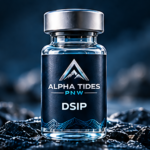
Research-grade DSIP should be accompanied by a Certificate of Analysis (COA) documenting purity — typically by HPLC — and confirming identity. Alpha Tides PNW supplies DSIP as a 10mg lyophilized powder; a batch-specific Certificate of Analysis is not currently attached to this product. Researchers should confirm documentation status directly before relying on a purity or identity figure for this compound.
Summary: Key Takeaways for Researchers
DSIP is a well-documented nonapeptide with a broad, multi-pathway research profile. The essential points are:
- Six overlapping research areas: sleep-architecture (delta-wave) regulation, stress-hormone/neuroendocrine modulation, MAPK cascade interaction, antioxidant activity, GABAergic interaction, and broader neurotransmitter effects — treated as a connected profile rather than isolated effects.
- Preclinical evidence: findings come primarily from animal models and in vitro systems; results are interpreted within that frame, not as an established clinical intervention.
- KLOW context: DSIP is one of four components in the KLOW blend, contributing the recovery/sleep-architecture element alongside GHK-Cu, BPC-157, and KPV.
- Documentation: confirm current COA status directly before relying on a specific purity or identity figure for this product.
Related Research Guides
- KLOW Blend: A Multi-Compound Research Formula for Recovery Studies
- DSIP 10mg (research compound)
- Certificates of Analysis
Research Use Only. DSIP and all compounds referenced here are intended strictly for laboratory research by qualified professionals. They are not FDA approved and are not for human or animal use. Nothing in this article constitutes medical, therapeutic, or dosing guidance.
Storage & Handling
- Before reconstitution: store lyophilized vials at −20°C, protected from light and moisture. Allow a vial to reach room temperature before opening to avoid condensation.
- After reconstitution: refrigerate at 2–8°C and use within roughly 14–28 days. Avoid repeated freeze-thaw cycles, which accelerate degradation.
- Recommended solvent: bacteriostatic water is the standard choice for multi-use reconstitution.
For full protocols, see the reconstitution and storage guides in the Related Research section.
Frequently Asked Questions
DSIP is studied primarily in sleep-architecture models — particularly slow-wave (delta) sleep — alongside research into stress-hormone modulation, MAPK/GILZ signaling, antioxidant activity, GABAergic interaction, and broader neurotransmitter systems in preclinical models.
KLOW combines four compounds with distinct research profiles: GHK-Cu (copper-peptide/tissue-remodeling research), BPC-157 (repair-pathway research), KPV (anti-inflammatory research), and DSIP (sleep-architecture and stress-hormone research). DSIP is the component most associated with neuroendocrine and sleep-cycle pathways rather than tissue repair directly.
Store lyophilized vials at −20°C away from light and moisture. After reconstitution with bacteriostatic water, refrigerate at 2–8°C and avoid freeze-thaw cycles.
A batch-specific Certificate of Analysis is not currently attached to this product. Check the product page directly for current documentation status before relying on a purity figure.
Bacteriostatic water is the standard solvent for multi-use laboratory reconstitution because its preservative supports repeated sterile access over the working life of the vial.
No. DSIP is supplied strictly for laboratory research by qualified professionals. It is not FDA approved and is not for human or animal use.
Research Compounds
Research Use Only — Not for Human or Animal Consumption. Content is provided for informational and educational purposes and does not constitute medical advice.
Continue Your Research
Browse the full catalog of COA-verified research compounds.
Shop All Compounds →