
GLP-3 is not a formally recognized hormone, receptor subtype, or pharmacological classification. The term is informal shorthand used in research circles to refer to AT-R3 (Reta), a synthetic triple-receptor agonist under active laboratory investigation. If you’re searching for “GLP-3,” you’re looking for AT-R3. This guide explains how the informal name emerged, what AT-R3 actually is, and what makes its triple mechanism a distinct subject of research compared to earlier GLP-class compounds. Researchers can source AT-R3 (Reta) for laboratory use directly from Alpha Tides PNW.
Why Is AT-R3 Called “GLP-3”?
The informal “GLP-3” label tracks a generational progression in GLP-receptor pharmacology that researchers simplified into a numbering system:
- First generation — GLP-1 agonists: Single-receptor compounds that activate the GLP-1 receptor (GLP-1R) and became central to metabolic research. Their mechanism influences glucose-stimulated insulin secretion, gastric motility, and appetite signaling in preclinical models.
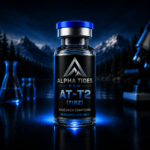
- Second generation — dual GLP-1/GIP agonists: AT-T2 (Tirz) co-activates GLP-1R and the glucose-dependent insulinotropic polypeptide receptor (GIPR). Research outcomes with dual agonists differed meaningfully from single-agonist compounds in metabolic and adipose tissue models, prompting “second-generation” framing among researchers.
- Third generation — triple agonists: AT-R3 adds glucagon receptor (GCGR) activation on top of GLP-1R and GIPR agonism. Researchers adopted “GLP-3” as informal shorthand for this third generational step, though the designation has no formal pharmacological standing.
Alpha Tides’ catalog designation for this compound is AT-R3 (Reta), classified as a triple GIP/GLP-1/glucagon receptor agonist.
What Is AT-R3 (Reta)?
AT-R3 is a synthetic peptide analogue designed as a balanced agonist at three G protein-coupled receptors: GLP-1R, GIPR, and GCGR. It is structurally related to the GLP-1 analogue class but incorporates modifications that enable meaningful activity across all three receptor pathways simultaneously.
The receptor coverage is what distinguishes AT-R3 from earlier research compounds:
| Compound | GLP-1R | GIPR | GCGR |
|---|---|---|---|
| Single-agonist GLP-1 compounds | ✓ | — | — |
| AT-T2 (Tirz) | ✓ | ✓ | — |
| AT-R3 (Reta) | ✓ | ✓ | ✓ |
The addition of GCGR agonism is the defining differentiator. While GLP-1R and GIPR agonism in research models have been associated with insulinotropic and adipose tissue effects, GCGR co-activation contributes to hepatic glucose output regulation and energy expenditure pathways not fully captured by dual-agonist models.
How the Triple Mechanism Works
GLP-1R — G protein-coupled signaling elevates intracellular cAMP. In research models this affects glucose-dependent insulin secretion, gastric motility, and hypothalamic appetite pathways.
GIPR — Also cAMP-mediated. In adipose tissue models, GIPR agonism has been associated with enhanced insulinotropic signaling and fat cell remodeling. Co-activation with GLP-1R is hypothesized to amplify metabolic responses in controlled research settings.
GCGR — Glucagon receptor activation drives hepatic glucose output in fasting models and activates thermogenic pathways in adipose tissue. This component provides the energy-expenditure dimension that separates triple-agonist research from dual-agonist work — and explains why AT-R3 has attracted distinct research interest beyond the GLP-1/GIP axis.
Research Applications
AT-R3 appears across several active laboratory research domains:
Body composition research: Studies in rodent models have examined AT-R3’s effects on fat mass and lean mass measures, with particular attention to the GCGR-mediated energy expenditure component. Researchers studying body composition compounds place AT-R3 in the metabolic peptide category alongside AT-T2 and other compounds under investigation for adipose and energy phenotypes.
Metabolic marker studies: Laboratory models have examined fasting glucose, lipid profiles, insulin sensitivity proxies, and liver enzyme markers in response to triple-agonist dosing protocols.
Hepatic phenotype models: The GCGR component draws specific interest for liver phenotype research, particularly hepatic lipid accumulation and hepatic glucose regulation in preclinical models.
Energy expenditure research: AT-R3’s glucagon receptor activity has been examined in thermogenic pathway models. The interplay between GCGR-driven energy expenditure and GLP-1R/GIPR-driven insulin dynamics creates compound research questions not easily isolated with earlier GLP-class tools.
All research applications referenced here are conducted in controlled laboratory settings. AT-R3 is sold for research use only and has not been approved for any therapeutic application.
Sourcing AT-R3 for Research
Alpha Tides PNW supplies AT-R3 as a lyophilized powder for laboratory use, available in 10mg, 15mg, 20mg, and 30mg vials. Batches are independently tested by Janoshik Analytical for identity and purity; Certificates of Analysis are available for most vial sizes on the product page. Not every vial size currently has documentation attached, so confirm COA availability for the specific size before relying on one.
Lyophilized AT-R3 should be stored at -20°C until reconstitution; see the peptide storage guide for handling protocols.
Explore AT-R3 (Reta) for research →
Summary: Key Takeaways for Researchers
“GLP-3” is a naming shortcut, not a compound. The essential points are:
- No such receptor: GLP-3 has no formal pharmacological standing — it is informal shorthand for AT-R3 (Reta), following a generational (1st/2nd/3rd) numbering convention among researchers.
- What AT-R3 actually is: a triple agonist activating GLP-1R, GIPR, and GCGR — the added GCGR pathway is what distinguishes it from dual-agonist compounds like AT-T2.
- Vial sizes: AT-R3 is supplied in 10mg, 15mg, 20mg, and 30mg vials; COA documentation currently covers most, but not every, size.
- Research use only: not evaluated by the FDA or approved for any therapeutic or diagnostic application.
Related Research Guides
- Retatrutide (AT-R3): Metabolic Research Guide — the full triple-agonist compound profile
- What Is Tirzepatide (AT-T2)? A Research Guide — the dual-agonist compound this one is compared against
- Multi-Compound Research Protocols — how AT-R3 fits into combination study designs
- More Research Guides — comparisons and explainers across compound classes
All products sold by Alpha Tides PNW are intended strictly for in vitro laboratory research and are not for human or animal consumption. These compounds have not been evaluated by the FDA and are not approved for any therapeutic or diagnostic use. Not intended to diagnose, treat, cure, or prevent any disease. Information on this page is provided for educational and research reference purposes only.
The compound(s) discussed in this article are available with a Certificate of Analysis on the Alpha Tides shop.
Frequently Asked Questions
No. GLP-3 has no formal pharmacological standing — it is informal shorthand researchers use for AT-R3 (Reta), a synthetic triple-receptor agonist. The name reflects a generational numbering pattern (single, dual, then triple agonists), not an actual third GLP receptor.
AT-T2 (Tirz) is a dual agonist engaging GLP-1R and GIPR. AT-R3 (Reta) adds glucagon receptor (GCGR) activation on top of those same two, making it a triple agonist. The added GCGR pathway is what separates the two in research applications.
It means the compound is studied for activity at three distinct G protein-coupled receptors — GLP-1R, GIPR, and GCGR — rather than one or two. Researchers use this framing to distinguish AT-R3 from single- and dual-agonist compounds in the same research family.
AT-R3 is supplied as a lyophilized powder in 10mg, 15mg, 20mg, and 30mg vials. Certificates of Analysis are available for most, but not necessarily every, vial size — check the specific size on the product page. Store lyophilized vials at −20°C until reconstitution; see the peptide storage guide linked below for full handling protocols.
No. AT-R3 is sold strictly for in vitro laboratory research and has not been evaluated by the FDA or approved for any therapeutic, diagnostic, or human application.
Research Compounds
Research Use Only — Not for Human or Animal Consumption. Content is provided for informational and educational purposes and does not constitute medical advice.
Continue Your Research
Browse the full catalog of COA-verified research compounds.
Shop All Compounds →