

GHK-Cu is a small copper-binding peptide that has sustained decades of research interest in skin, wound, and tissue-remodeling models. This guide explains what GHK-Cu is, how its copper complex shapes the pathways it is studied in, and how it should be handled in the laboratory. It is intended for qualified researchers and makes no human-use, therapeutic, or dosing claims.
Because GHK-Cu couples a peptide to a coordinated metal ion, it behaves differently from a plain peptide in both its studied activity and its handling. The sections below cover its structure and origin, the mechanisms most often examined, common study categories, study-design considerations, handling, and documentation.
What Is GHK-Cu?
GHK-Cu is a tripeptide composed of three amino acids — glycine, histidine, and lysine (Gly-His-Lys) — bound to a copper(II) ion. The GHK sequence has a naturally high affinity for copper, and the resulting complex is what researchers refer to as GHK-Cu. GHK was first isolated from human plasma, and its concentration in tissue is observed to decline with age in research models, which is part of why it is frequently studied in the context of tissue maintenance and remodeling.
Because copper coordination is central to its studied activity, GHK-Cu is supplied and handled as a distinct complex rather than as the bare peptide. It is provided as a lyophilized powder for research use and reconstituted before laboratory application, with care taken to preserve both the peptide chain and the coordinated metal.
Discovery and Research Background
GHK was identified in human plasma during investigations into factors that influence tissue behavior with age. Researchers observed that the tripeptide binds copper avidly and that the copper complex is associated with the activity studied in subsequent work. This age-related decline in tissue GHK levels framed much of the early research, positioning the complex as a tool for studying tissue-maintenance and remodeling pathways.
Over time, interest broadened from collagen-centered studies toward systems-level analyses using gene-expression profiling. As with other research compounds discussed here, GHK-Cu findings are drawn from cell and animal models and are interpreted within a preclinical framework.
Studied Mechanisms and Pathways
Collagen and Extracellular Matrix Signaling
The most extensively studied property of GHK-Cu is its association with collagen and extracellular-matrix (ECM) synthesis in preclinical models. Research has examined how the complex influences fibroblast activity and the expression of matrix components involved in tissue structure and remodeling, making it a frequent tool in dermal and connective-tissue studies.
Copper Transport and Enzymatic Cofactor Roles
Copper is a cofactor for several enzymes involved in connective-tissue formation and antioxidant defense. GHK-Cu is studied as a copper-delivery model, with research exploring how bioavailable copper participates in these enzymatic pathways and how the peptide carrier affects that delivery relative to free copper salts.
Gene-Expression Modulation
More recent work has used gene-expression profiling to examine how GHK influences broad sets of genes associated with tissue repair, remodeling, and antioxidant response. This systems-level view expanded interest in the peptide well beyond its classic collagen associations and is now a significant strand of the literature.
Common Research Applications
- Wound and tissue-repair models: dermal remodeling and ECM studies in preclinical settings.
- Collagen-synthesis research: fibroblast activity and matrix-component expression.
- Antioxidant and copper-biology studies: copper-dependent enzymatic pathways.
- Skin-aging research models: age-related changes in tissue-maintenance signaling.
- Gene-expression studies: profiling remodeling and antioxidant gene sets.
Research Considerations and Study Design
Because the copper complex defines GHK-Cu’s studied activity, purity and identity verification carry extra weight — the ratio of peptide to coordinated copper is part of what makes the material behave as expected. Researchers should treat both peptide purity and correct copper coordination as documented parameters. Light exposure and oxidation are particular concerns for copper complexes, so handling and storage discipline directly affect data quality.
Model selection matters as well: a fibroblast collagen-synthesis assay and a gene-expression profiling study place different demands on the material and the readouts. As always, appropriate vehicle and copper-salt controls help distinguish effects attributable to the intact GHK-Cu complex from those of copper alone.
Quality and Documentation
Because the copper complex is central to GHK-Cu’s studied activity, purity and identity verification are important. A batch-specific Certificate of Analysis documenting HPLC purity and identity should accompany research-grade material. Recording the COA identifiers with experimental notes ties results to the exact material used.
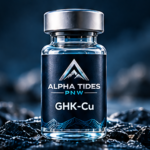
Alpha Tides PNW supplies GHK-Cu 50mg as a research-grade compound with documentation available on request.
Comparison with Related Repair Compounds
GHK-Cu occupies a distinct niche among compounds studied for tissue repair. Where BPC-157 is a 15-amino-acid peptide associated with angiogenesis and gastrointestinal-repair models, and TB-500 is a Thymosin Beta-4 fragment associated with actin regulation and cell migration, GHK-Cu is fundamentally a copper-delivery complex whose studied activity is inseparable from its coordinated metal. This makes it a complementary rather than interchangeable research tool: investigators studying collagen synthesis and extracellular-matrix remodeling often select GHK-Cu specifically because of its copper-dependent enzymatic associations.
This complementarity is one reason GHK-Cu appears in multi-compound recovery formulations alongside peptides that act through unrelated pathways. In such research contexts, GHK-Cu contributes the copper-dependent remodeling arm while other compounds contribute their own distinct mechanisms, allowing researchers to model how multiple repair pathways behave in combination. When designing comparative studies, it is important to treat GHK-Cu’s metal coordination as a defining variable rather than a background detail, since it separates the complex both mechanistically and analytically from metal-free repair peptides. Appropriate controls — including free copper salts and the metal-free peptide where feasible — help attribute observed effects to the intact complex.
Related Research Guides
- KLOW Blend: Multi-Compound Recovery Research
- GHK-Cu 50mg (research compound)
- Certificates of Analysis
Research Use Only. GHK-Cu and all compounds referenced here are intended strictly for laboratory research by qualified professionals. They are not FDA approved and are not for human or animal use. Nothing in this article constitutes medical, therapeutic, or dosing guidance.
Storage & Handling
Copper-peptide complexes require care to preserve both the peptide and the coordinated metal.
- Before reconstitution: store lyophilized vials at −20°C, protected from light and moisture.
- After reconstitution: refrigerate at 2–8°C, minimize light exposure, and avoid repeated freeze-thaw cycles.
- Recommended solvent: bacteriostatic water; handle under sterile technique.
Frequently Asked Questions
GHK-Cu is studied primarily in collagen synthesis, extracellular-matrix remodeling, wound-repair models, copper-dependent enzymatic pathways, and gene-expression profiling in preclinical research.
The GHK tripeptide has a natural high affinity for copper ions, and the copper complex is central to the activity studied in the literature. This is why it is handled as the GHK-Cu complex rather than the free peptide.
Store lyophilized vials at −20°C away from light and moisture. After reconstitution with bacteriostatic water, refrigerate at 2–8°C and avoid freeze-thaw cycles.
Bacteriostatic water is the standard solvent for multi-use laboratory reconstitution. See the reconstitution guide for technique and volume considerations.
Research-grade GHK-Cu is typically supplied at high purity with a batch-specific COA documenting identity and HPLC purity.
GHK-Cu is a peptide-metal complex; the coordinated copper is essential to its studied activity, so it requires more attention to light, oxidation, and copper coordination than a metal-free peptide.
Research Compounds
Research Use Only — Not for Human or Animal Consumption. Content is provided for informational and educational purposes and does not constitute medical advice.
Continue Your Research
Browse the full catalog of COA-verified research compounds.
Shop All Compounds →